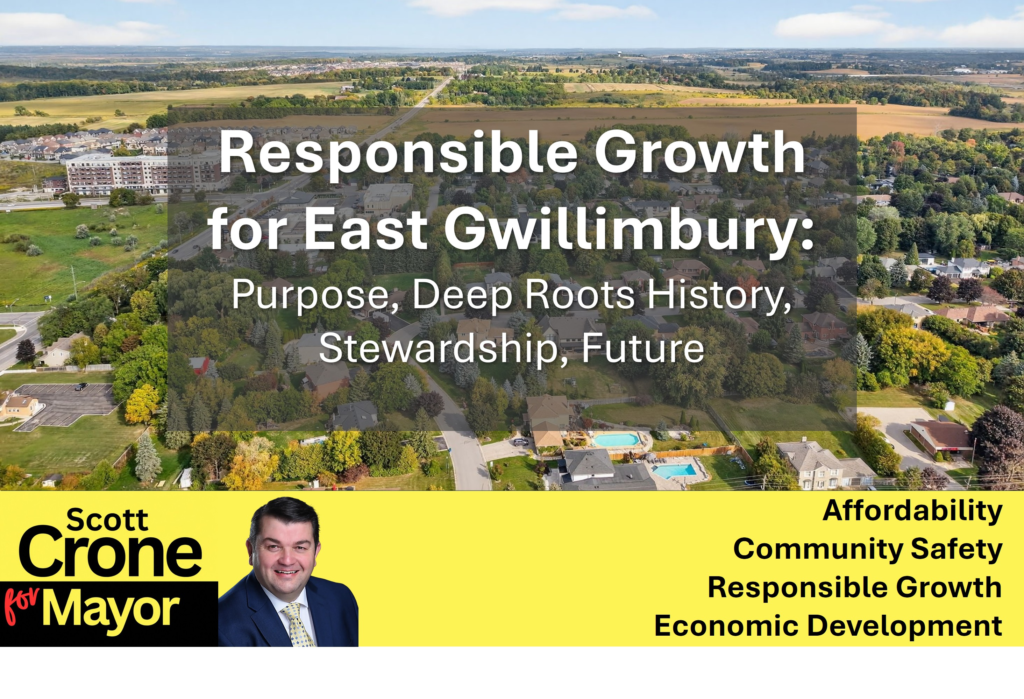
Responsible Growth for East Gwillimbury: Purpose, Deep Roots History, Stewardship, Future
Voters deserve to know exactly where the mayoral candidates stand on growth. I made my position clear at my campaign launch when I said, “As Mayor, I will not be a head waiter for the development industry.” I meant it then, and I stand by it now. Eight years on Council have taught me things that only come with experience: how to learn from mistakes, what questions to ask when a new development proposal comes before Council, and, just as importantly, when to say no.
Residents are rightly concerned about the pace and scale of development in recent years, and responsible growth is how we answer that concern. It means growing our community without outgrowing our ability to support it. Growth is inevitable, but how we grow is a choice, and I choose to do it responsibly. That means building infrastructure before we need it, not after; making sure development pays its fair share instead of residents footing the bill; protecting our environment and agricultural lands; and ensuring growth improves quality of life for new and existing residents alike.
The Purpose of Responsible Growth in EG
I’ve said it before and I’ll keep saying it: I don’t want East Gwillimbury to be the fastest growing municipality in Canada again. That kind of title looks good in a headline, but growth for its own sake doesn’t build a stronger town, it strains one. We must protect our green spaces, farmland, and natural heritage while building complete communities where people can actually live, work, and thrive.
As Mayor, I will advocate for growth that serves the people of East Gwillimbury first, growth that enhances our quality of life, not undermines it.
My commitments:
- Champion the principle that growth pays for growth; developers, not residents, bear the cost of development.
- Defend our Official Plan and fight for it at the Ontario Land Tribunal when necessary.
- Pursue a more balanced and diverse mix of housing options throughout the community.
- Ensure growth never exceeds our infrastructure capacity to service it responsibly.
- Use our water and wastewater allocation as a deliberate, strategic instrument for managing growth.
- Keep East Gwillimbury 83% green, protecting our parks, trails, and farmland for future generations.
Ten Pillars of Responsible Growth
Beyond the commitments above, residents deserve a clear picture of what responsible growth actually requires, in practice, from Council. These are the ten pillars I’ll hold this Town to.
Infrastructure Planning
Roads, water, sewage, and utilities have to keep pace with new development, not chase it after the fact. Every growth management workshop I’ve sat through as a Councillor has reinforced the same lesson: when infrastructure planning lags behind approvals, residents are the ones who feel it first, in longer commutes, strained sewage allocation, and services that can’t keep up with the population moving in.
Fiscal Accountability
Transparent management of municipal budgets and development levies is what keeps growth from quietly becoming a tax burden on the people who already live here. Every strategic plan, every annual report, and every community report the Town publishes should make it easy for residents to see exactly how development-related revenue is raised and spent, not just that it was.
Environmental Stewardship
Protecting wetlands, greenbelts, and natural heritage features during growth is non-negotiable for me. It’s the same environmental sustainability I championed as a founding member of East Gwillimbury’s Environmental Advisory Committee, and it’s why I’ll keep pushing for growth that works with our natural environment instead of paving over it.
Community Engagement
Meaningful public consultation has to happen before major planning decisions are approved, not after a proposal is already before Council. Residents should be able to subscribe to updates, attend a growth management workshop, or read a community report and actually shape the direction of a development, not just be informed of it once the terms are already set.
Density Management
Balancing housing supply needs with neighbourhood character and liveability means recognizing that density has to be the right fit for the right area. A recreation facility, a school, or a stretch of active living amenities only serves a neighbourhood well if the population around it was planned for, not just accommodated after the fact.
Developer Accountability
Holding builders to their commitments, on timelines, amenities, and community benefits, is how the Town makes sure a development proposal on paper actually becomes the healthy, strong community residents were promised. Too often, amenities promised at approval get quietly deferred once a project is underway. I’ll push for a Council direction that keeps developers to their word.
Official Plan Compliance
Every growth decision needs to align with our approved municipal and provincial planning frameworks. That includes standing firm on our Official Plan, including at the Ontario Land Tribunal when it’s challenged, so that East Gwillimbury Council isn’t negotiating our long-term vision project by project.
Transit and Mobility
Integrating public transit and active transportation into new development areas, connecting East Gwillimbury, Newmarket, Aurora, and the broader York Region, is key to reducing our reliance on cars and building genuinely complete communities. Growth that adds population without adding mobility options just adds congestion.
Affordable Housing
Including attainable housing options within our growth plans means East Gwillimbury has to offer opportunities for young families, seniors, and essential workers, not just move-up buyers. A more balanced and diverse mix of housing is both a fairness issue and an economic one: the businesses and services we want here need employees who can actually afford to live here.
Long-Term Vision
Guiding growth through a coherent, resident-first strategic plan is what ties every one of these pillars together. East Gwillimbury doesn’t need a growth strategy that resets with every new development proposal; it needs one long-term vision that Council, staff, and residents are all building toward together.
Responsible Growth History in EG
My family’s history here isn’t abstract to me. I’m a sixth-generation East Gwillimbury resident, with roots throughout this town, and I grew up around farming, a family bakery, and a Christmas tree farm. When you’ve grown up watching a field turn into a harvest instead of a subdivision, you understand something about this land that doesn’t show up in a development charges report: it’s finite, and it’s worth protecting.
That’s part of why I was a founding member of East Gwillimbury’s Environmental Advisory Committee, and why so much of my Council work has focused on things like stronger fill enforcement by-laws, expanding our EV fleet and infrastructure, and adding cost-saving green options for new facilities. But protecting the environment and growing our economy aren’t competing priorities; they reinforce each other. Our green spaces, farmland, and natural heritage are exactly what make East Gwillimbury attractive to the businesses and residents we want to bring here. Responsible economic development builds on that natural heritage instead of paving over it, and it strengthens our tax base in a way that eases the burden on residential taxpayers rather than adding to it.
Responsible Growth Stewardship for Residents, Not the Other Way Around
Responsible growth is about sequencing and stewardship: infrastructure before density, community input before approvals, and environmental protection alongside economic development, not in competition with it. It’s about making sure new growth strengthens our workforce, our local businesses, and our infrastructure, and pays its own way, instead of quietly shifting costs onto the people who already call East Gwillimbury home.
Growth also has to serve our broader economic development strategy. New investment, new jobs, and new business opportunities are welcome, but only when they’re matched by the health, recreation, and municipal services a growing population actually needs. A strong local economy and a healthy, liveable community aren’t in tension, they’re the same goal, viewed from two directions.
East Gwillimbury doesn’t need to be the fastest growing municipality in Canada. It needs to be one of the best-run, with 83% of our landscape staying green for the generations who’ll grow up here after us. That’s the growth I’m asking for the chance to lead as your next Mayor.
Scott Crone